Local provider keys
Keep upstream provider credentials in gateway config while clients use gateway-facing tokens.
 SSC-STUDIO / Ai-Model-Gateway
Use this checklist before adopting a self-hosted LLM gateway for provider keys, routing policy, telemetry, provider fallback, config publish, rollback, client compatibility, quality evidence, and security.
If the checklist confirms a fit for your self-hosted LLM operations workflow, star the repository after evaluation so more operators can find it.
Adoption fit
AI Model Gateway is useful when the gateway is part of your infrastructure boundary. It keeps provider keys, routing policy, request telemetry, audit records, diagnostics, and rollback workflows inside your environment instead of outsourcing the control plane to a hosted broker.
Keep upstream provider credentials in gateway config while clients use gateway-facing tokens.
Centralize model routing, fallback preferences, health checks, and cooldown behavior in one local runtime.
Review traffic, latency, request logs, provider health, diagnostics, and cost signals from the Admin UI.
Preview, diff, validate, config publish, audit, and rollback gateway changes before they affect traffic.
Shortest proof
The executable provider fallback demo starts fake OpenAI-compatible upstreams. The primary returns 429, the gateway serves the fallback provider, rewrites the forwarded model, and records the fallback route mode.
go test ./examples/provider-fallback -run TestProviderFallbackDemo -v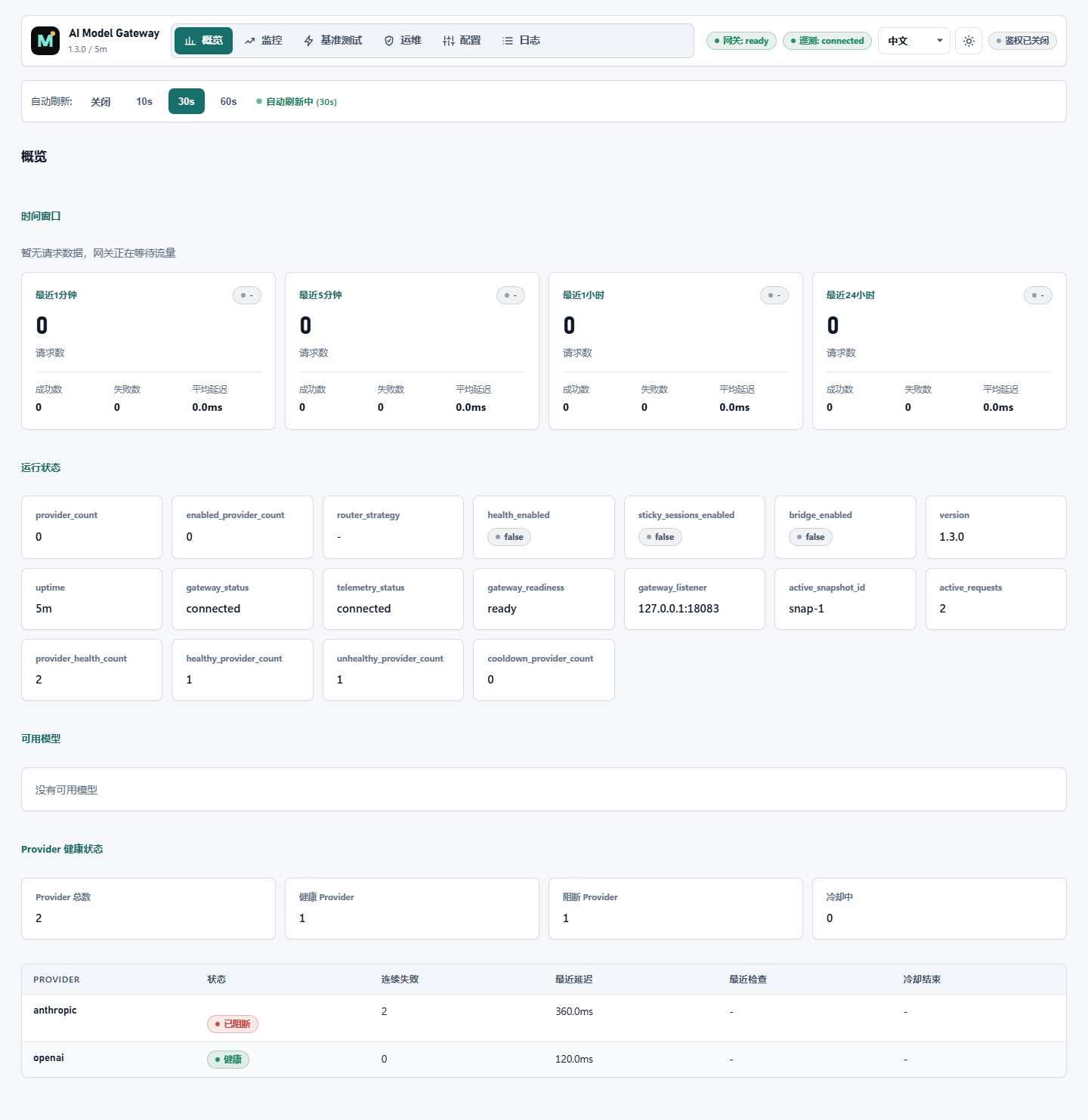
Checklist
Scope
The gateway supports OpenAI-compatible, Anthropic-compatible, and Responses-style entry points, but each client and upstream should be smoke-tested before production use. It does not claim to replace every hosted platform feature, account workflow, or provider-specific capability.
Review evidence
Review CI gates, local reproduction commands, runtime smoke checks, feature proof points, and current capability boundaries.
Open quality evidenceInspect admin auth, same-origin browser writes, provider-key handling, SSRF defenses, telemetry sensitivity, local files, and update trust.
Open security modelCompare the project against broader gateway, observability, and hosted routing options before committing operational ownership.
Open gateway comparisonDecision
Start with one non-production request, the fallback demo, and the review evidence. If AI Model Gateway fits your self-hosted LLM gateway workflow, Star on GitHub so similar operators can discover it.