Local key control
Keep provider credentials and client-facing gateway tokens under your own runtime and deployment controls.
 SSC-STUDIO / Ai-Model-Gateway
Run model traffic through a local gateway layer that keeps provider keys, routing policy, telemetry, config changes, diagnostics, updates, and rollback inside your own environment.
If this fits your internal LLM gateway workflow, star the repository after evaluation so other operators can find it.
Why self-host
A hosted broker can be useful for quick model access. AI Model Gateway is for teams that need the gateway itself to be part of operations: owned keys, explicit routing policy, visible provider health, auditable config changes, and a rollback path.
Keep provider credentials and client-facing gateway tokens under your own runtime and deployment controls.
Use one local entry point for OpenAI-compatible clients while managing provider routing and fallback centrally.
Inspect traffic, latency, cost signals, request logs, provider health, diagnostics, and replay from the Admin UI.
Preview, diff, validate, publish, audit, and roll back config changes instead of editing a live proxy file.
Shortest proof
The 15-minute evaluation path starts with fit checks, local runtime startup, the provider fallback demo, and the key operations docs. The demo forces a primary OpenAI-compatible upstream to return 429 and verifies the request is served through a fallback provider.
go test ./examples/provider-fallback -run TestProviderFallbackDemo -v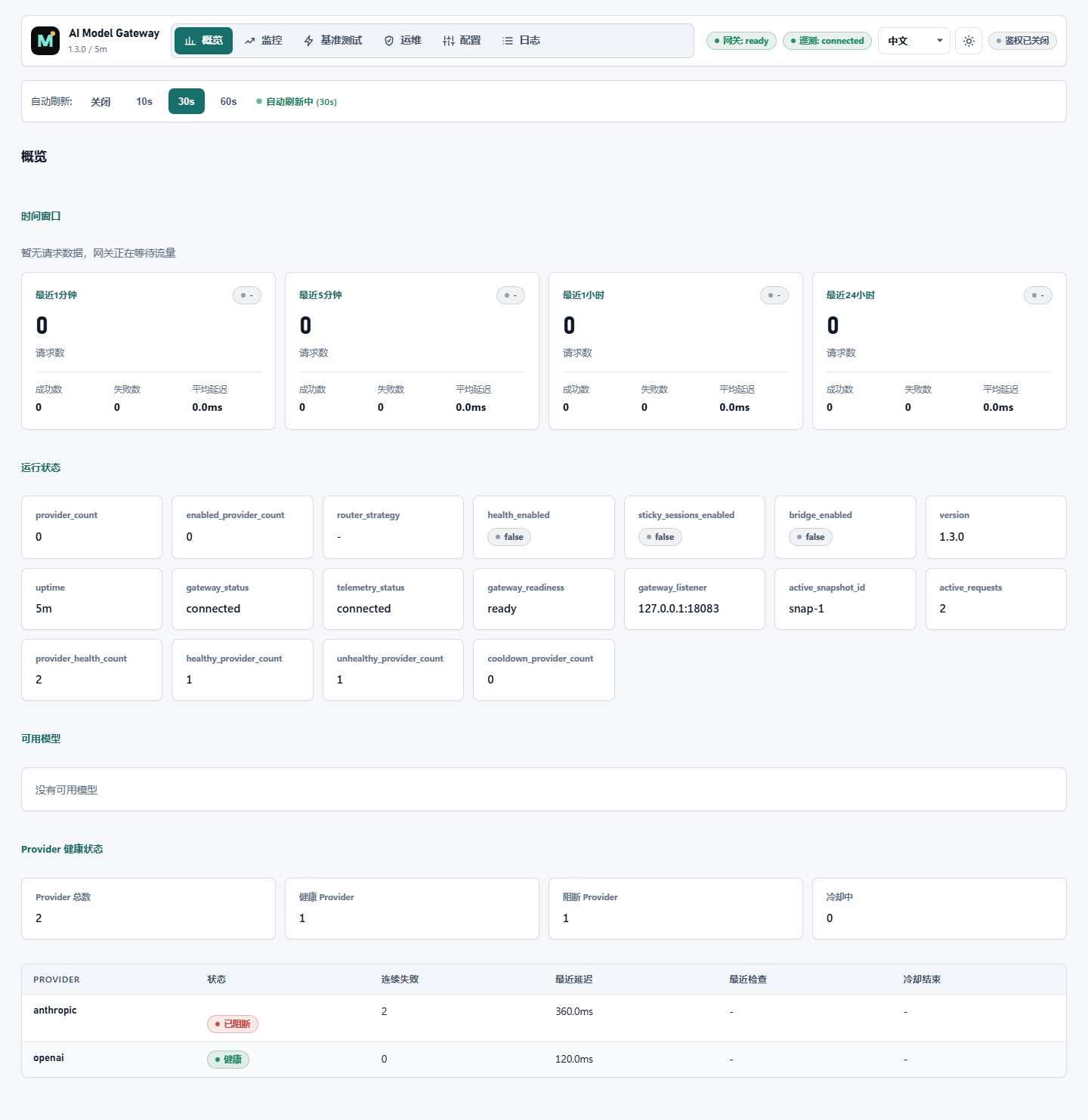
Evaluation path
Fit check
Review evidence
Try the packaged v1.4.4 runtime with checksum verification, local config, runtime directories, and supervised startup commands.
Open release install pathReview CI gates, local reproduction commands, runtime smoke checks, feature proof points, and current capability boundaries.
Open quality evidenceInspect admin auth, same-origin browser writes, provider-key handling, SSRF defenses, telemetry sensitivity, and update trust.
Open security modelNext step
Start with the checklist and executable fallback demo. If the project matches your self-hosted LLM gateway needs, starring the repository helps more operators discover it.