Repository
Main project page, README, CI badge, source code, issues, release links, and star action.
Open GitHub repo AI Model Gateway
Copy-ready links and short posts for introducing AI Model Gateway to operators evaluating self-hosted LLM routing, fallback, telemetry, config publishing, and rollback.
Share with teams that operate internal LLM traffic. Ask for technical feedback first; star requests should stay conditional on fit.
Start links
Main project page, README, CI badge, source code, issues, release links, and star action.
Open GitHub repoPackaged v1.4.4 archives, checksum verification, local config, runtime dirs, and supervised startup.
Open quick trialInstallability, CI gates, runtime smoke checks, feature proof, security boundaries, and release evidence.
Open review evidencePreview card
The social preview card is a 1200x630 image backed by actual Admin UI screenshots. Use it for posts that need a visual instead of generic gateway copy.
Open social card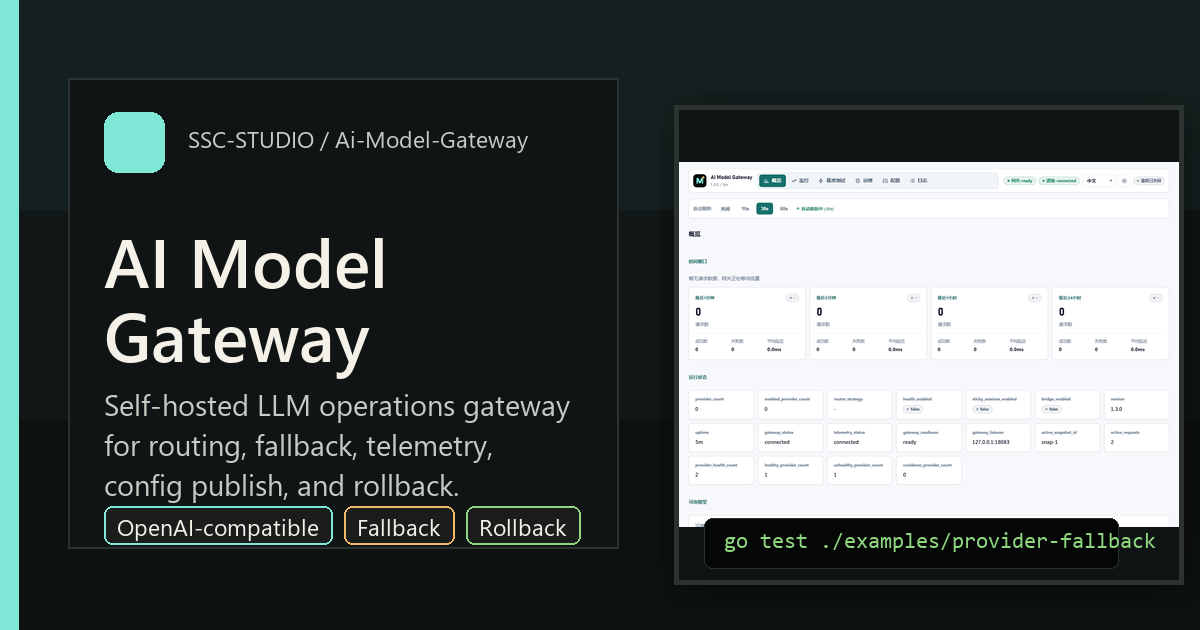
Copy blocks
AI Model Gateway is a self-hosted LLM operations gateway in Go.

It focuses on local control: OpenAI/Anthropic-compatible entry points, provider routing and fallback, telemetry, benchmarks, config publish/rollback, diagnostics, and manifest-verified updates.

Repo: https://github.com/SSC-STUDIO/Ai-Model-Gateway
Fast trial: https://github.com/SSC-STUDIO/Ai-Model-Gateway#try-it-quicklyI am looking for feedback from people running internal LLM gateways or proxy layers.
What provider failure modes matter most in production: 429s, timeouts, quota exhaustion, slow endpoints, config mistakes, or observability gaps?
Project: https://github.com/SSC-STUDIO/Ai-Model-Gateway
Review evidence: https://ssc-studio.github.io/Ai-Model-Gateway/#review-evidenceAudience fit
Support discovery
If the project matches a self-hosted LLM operations workflow, a GitHub star helps other operators find it. If not, technical feedback is more useful than a star.